Show the Mess: Why Half-Finished Work Tells a Truer Story Than Your Best Piece
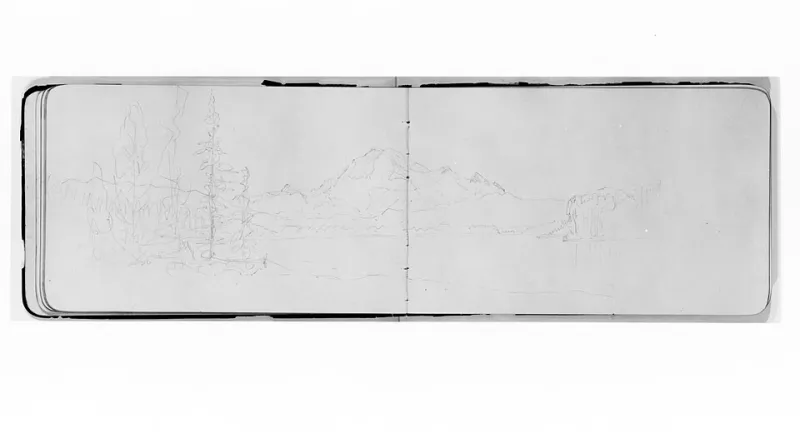
Photo: Albert Bierstadt, CC0, via Wikimedia Commons
Somewhere along the way, we got this idea that a portfolio is a trophy case. You put in the wins. You hide the losses. You curate yourself into a highlight reel and hope the right person scrolls far enough to care.
But here's the thing — the work that's still breathing, still becoming something, often says more about who you are than anything you've called finished.
The Myth of the Perfect Final Product
There's a version of creative presentation that's been drilled into most of us since art school: show only your best. Don't let them see you sweat. Present the work as if it arrived fully formed, confident, inevitable.
And in certain contexts, that discipline still matters. You're not going to send a client a folder of half-baked sketches and call it a proposal. That's not what this is about.
But there's a difference between professional delivery and the ongoing myth that great work doesn't have an ugly middle. It always does. The ugly middle is where the actual decisions get made — where you figure out what you actually think about a problem, what you're willing to kill, and what you're not.
Hiding that from your audience doesn't make you look more competent. It just makes you look less human.
What Japanese Creative Practice Gets Right About Process
In a lot of Japanese artistic traditions, the making is inseparable from the meaning. You see this in ceramics, in calligraphy, in the practice of shodō — where the gesture that produces the mark is as important as the mark itself. The process isn't backstory. It's part of the work.
Wabi-sabi, that much-discussed aesthetic philosophy, isn't just about things that look worn or imperfect. It's about the honesty of impermanence — the idea that something in-progress, something incomplete, has its own integrity. It hasn't been smoothed over. It still shows where it came from.
American creative culture is slowly catching up to this. You can see it in the popularity of "making of" content, in the appetite for studio tours and process videos, in the way behind-the-scenes footage often outperforms the final product on social media. People aren't just interested in what you made. They want to know how you think.
The Iteration Pile Is Actually Your Argument
When you show the iterations — the three versions of the logo that didn't work, the color study that led somewhere unexpected, the sketch that was the wrong answer but pointed toward the right one — you're not showing weakness. You're showing rigor.
You're making an argument for your judgment. Because judgment isn't just the final call. It's the whole sequence of calls that got you there.
For bicultural creatives especially, this kind of layered presentation can be a genuine differentiator. If you're working between aesthetic traditions — say, bringing a Japanese sensibility into an American commercial context — the friction points in your process are actually where the most interesting things happen. That moment where you had to decide whether to simplify or to hold the complexity? That's a story worth telling.
And the people who connect with that story are going to be far more aligned with your actual work than someone who just liked the final jpeg.
Abandoned Ideas Aren't Failures — They're Evidence
There's a particular kind of creative courage in showing the thing you tried and walked away from. The direction that seemed promising until it didn't. The concept you loved but couldn't make work for this specific problem.
Abandoned ideas are evidence that you have standards. They show that you know the difference between something that's technically complete and something that's actually right.
A lot of designers and artists are sitting on years of this material — sketchbooks full of almost-theres, hard drives full of comps that never shipped — and treating it all like something to be ashamed of. That's a waste of some genuinely interesting creative documentation.
Consider what it would look like to actually present one of those abandoned threads. Not as a failure, but as a choice. "Here's where I started. Here's what I learned. Here's why I turned left instead of right." That's a portfolio entry that teaches someone something about how you work.
How to Show Process Without Oversharing
There's a balance here, obviously. Not everything needs to be aired out. Some work-in-progress is genuinely not ready for an audience, and some behind-the-scenes content is just noise.
The question is whether the thing you're sharing adds to the understanding of the finished work — or of you as a creative thinker. If it does, it earns its place. If it's just there to seem relatable, it probably isn't.
A few things that tend to work:
Early sketches alongside final outputs. Let people see the distance you traveled. The gap between the rough and the resolved is where your thinking lives.
A brief note on what you tried and why it didn't work. One or two sentences. You don't need to write an essay — just enough to make the decision visible.
Process work that shows a different side of your range. Sometimes the sketches are looser, more expressive, less controlled than the polished work. That's not a problem. That's texture.
The project that almost happened. The concept that got far enough to be interesting but never made it to production. These are often some of the most creatively honest things in a body of work.
The Audience You Actually Want
Here's the real reason to show the mess: it filters for the right people.
Someone who only wants to see the finished, polished, perfect version of your work is probably not going to be comfortable with how you actually work. And that mismatch will show up eventually — in the brief, in the revision process, in the way they respond when you push back on a direction.
But someone who looks at your process work and gets more interested? That person already understands something important about you. They're not just buying the output. They're buying the thinking.
That's a much better relationship to start from.
Your best piece might get you in the door. But the unfinished stuff — the honest, still-figuring-it-out, this-is-how-my-mind-works material — that's what makes someone decide to stay.