Stop Trying So Hard: The Counterintuitive Secret Behind Your Most Memorable Work

Ask any working artist about the piece they're most proud of, and there's a decent chance they'll tell you it almost didn't happen. It was made in an afternoon when they had nothing to prove. They were killing time, or warming up, or just messing around. They weren't trying to make something good. They were just making something.
And then somehow — somehow — it was the best thing they'd done in months.
This is not a coincidence. It's not luck. It's something closer to a law.
The Excellence Trap
There's a particular flavor of creative paralysis that hits when the stakes feel high. A big client. A portfolio piece. Something you've been building toward. You sit down to work and immediately the inner critic shows up — not to help, but to audit. Is this good enough? Is this original? Has someone done this before? Is this even the right direction?
The result is usually one of two things: either you produce something technically competent and completely forgettable, or you produce nothing at all. The obsession with excellence becomes a ceiling rather than a floor.
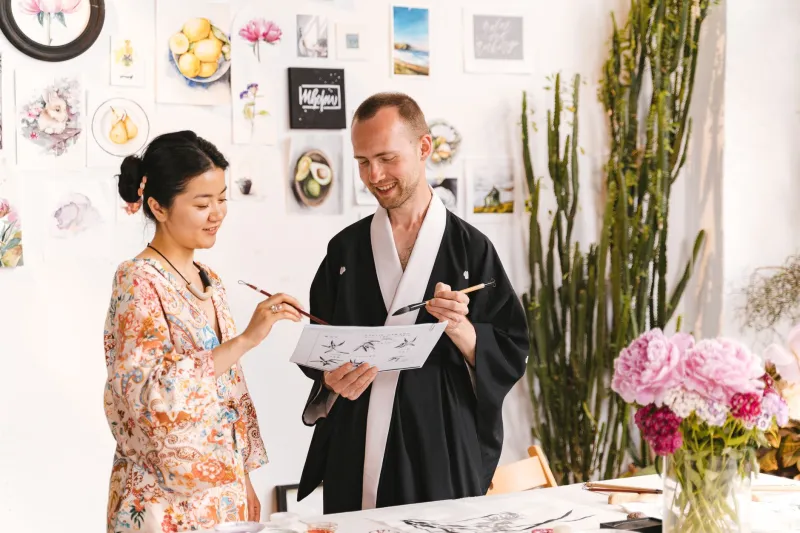
Japanese aesthetics have a useful concept here. In Zen-influenced arts — calligraphy, ceramics, ink painting — there's an understanding that the most alive work comes from a state of mushin, sometimes translated as "no mind" or "empty mind." Not blankness, but the absence of self-conscious evaluation. The brush moves because the brush moves, not because the artist is monitoring whether the stroke is good.
This isn't mysticism. It's neuroscience with older branding.
What's Actually Happening in Your Brain
When you're trying hard to make something excellent, you're engaging the prefrontal cortex — the part of your brain that evaluates, compares, and judges. That's useful for revising. It's actively counterproductive for generating. The prefrontal cortex doesn't know how to make something new. It only knows how to assess whether something matches a model it already has.
Original work, by definition, doesn't match existing models. So when you're in heavy evaluation mode during the generative phase, you're filtering out the very ideas that are actually interesting — because they don't fit the template of what "good" is supposed to look like.
The mental state that produces memorable work is closer to play. Low stakes. Genuine curiosity. A willingness to follow a thread even if you don't know where it goes. This is why so many artists — across cultures, across centuries — have described their best work as feeling like it came through them rather than from them. That's not spiritual bypassing. That's what it feels like when the evaluative brain steps aside long enough to let something genuinely new arrive.
The American Problem With Play
Here's where it gets culturally specific. American creative culture has a complicated relationship with play. There's a dominant narrative that great work requires grinding — visible effort, long hours, the romantic suffering of the serious artist. "Easy" work is suspect. If something came quickly, it probably isn't that good. If you enjoyed making it, you probably weren't working hard enough.
This is mostly wrong, and it's costing people their best ideas.
Think about some of the most influential American creative moments: Miles Davis recording Kind of Blue in essentially two sessions with minimal preparation. Jack Kerouac's famous scroll draft of On the Road. The entire aesthetic of skateboard culture, which built a visual language out of boredom and concrete and whatever was lying around. None of these came from someone trying very hard to make something important. They came from people doing what felt alive in the moment.
The trying came later — in editing, in refinement, in the long work of developing craft. But the spark? The spark came from somewhere looser.
How to Cultivate Accidental Brilliance (On Purpose)
The paradox here is real but navigable. You can't force the no-mind state, but you can create conditions that make it more likely. A few things that actually work:
Give yourself a project that doesn't count. Not everything needs to be for someone or toward something. Keep a sketchbook, a side folder, a throwaway file where you make things purely for the experience of making them. The work that lives there often turns out to be more interesting than the work you were trying to make.
Constrain yourself into play. Deadlines and limitations, weirdly, can quiet the inner critic. Thirty-minute sketches. One-color restrictions. Making something using only materials within arm's reach. Constraints shift the brain from evaluation mode into problem-solving mode, and problem-solving is much closer to the generative state you're after.
Start in the middle. Don't begin with the piece you want to make. Begin with something adjacent — a warmup, a study, a version you're explicitly not keeping. By the time you've decided the warmup is done, you're often already in the right mental state to work, and sometimes the warmup was the piece all along.
Change the stakes mid-process. If something starts to feel precious — if you're hovering and second-guessing — deliberately do something to it that you can't undo. Make a mark. Add something unexpected. Ruin it a little. This sounds destructive, but it often frees the work from the weight of your expectations.
The Work That Stays With People
Look back at your own portfolio with honest eyes. The pieces that still feel alive — the ones you'd actually show someone who mattered — where did they come from? My guess is that a surprising number of them came from a day when you weren't trying to make a career-defining piece. You were just working.
That's not a fluke. That's information.
The goal isn't to stop caring about quality. It's to stop letting the caring happen at the wrong moment in the process. Make freely. Evaluate later. The work that emerges from genuine play doesn't look like play — it looks like exactly what it is: something only you could have made, in exactly that moment, without trying.