They Said 'I'll Know It When I See It' — So Now What?
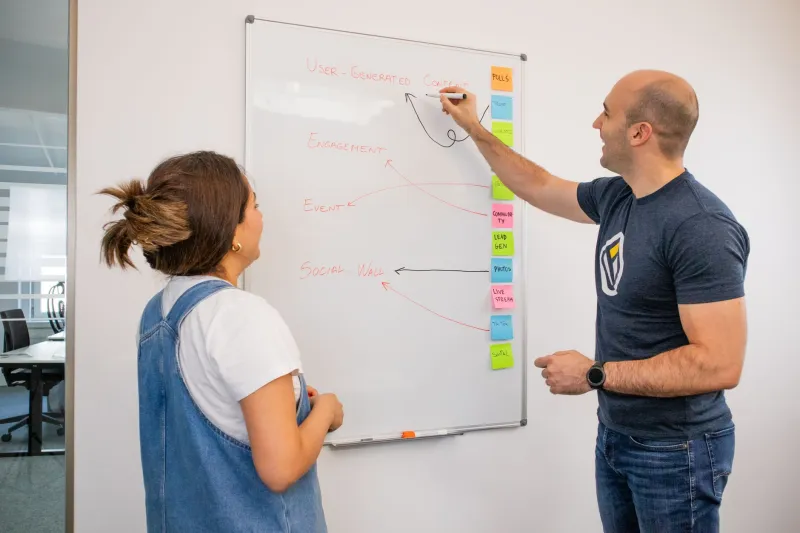
There's a particular kind of silence that happens in a client kickoff meeting. You've asked all the right questions — what's the mood, what's the audience, what do you want people to feel — and the person across the table looks at you with something between hope and apology and says: "I'm not sure. I just want it to feel... right."
Welcome to the real brief.
If you've been designing long enough, you know this isn't a failure of communication. It's actually the most honest thing a client can say. They don't know what they want because they haven't seen it yet. That's not their job. That's yours.
The Trend-Chasing Trap
Here's what usually happens when clients come in underprepared: they fill the vacuum with references. They've been scrolling Pinterest for two weeks. They've got a folder of screenshots — some brutalist typography, a pastel gradient from a skincare brand, a logo that looks like it belongs to a Brooklyn coffee shop that opened in 2019 and closed in 2021. None of it coheres. All of it says I've been anxious about this and trying to solve that anxiety with aesthetics.
American clients, particularly in consumer-facing industries, are under enormous pressure to look current. There's a cultural obsession with relevance — with not seeming behind. So they arrive at the designer's door not with a vision but with a fear: the fear of looking wrong, dated, or invisible. The references aren't a brief. They're a symptom.
The mistake a lot of designers make here is taking those references at face value. They build a moodboard that synthesizes the screenshots, present three directions that all look vaguely like things that already exist, and wonder why the client keeps saying "it's close, but not quite." You can't solve anxiety with more visual noise. You have to go upstream.
What They Mean vs. What They Say
There's a concept in Japanese craft culture sometimes described as reading the ma — the space between what's spoken and what's meant. A client who says "clean but edgy" is usually telling you two things simultaneously: they're afraid of being boring, and they're afraid of alienating people. Those are contradictory fears, and they're both real. Your job isn't to pick one. Your job is to find the design that holds both without collapsing.
Practically, this means asking different questions. Not "what do you like?" but "what do you not want to feel?" Not "who's your competitor?" but "who do you want to be nothing like, and why?" The negatives often carry more signal than the positives. People are much clearer about what embarrasses them than what excites them.
Try this: in your next kickoff, after you've gone through the standard discovery questions, ask the client to describe their worst-case scenario for this project. What's the version that would make them cringe? What would make them feel like they'd made a mistake? The answers will tell you more about their actual values — and their actual audience — than any number of reference images.
Ambiguity Is Not the Enemy
There's a tendency in American design culture to treat vagueness as something to be eliminated as quickly as possible. Get the brief locked. Get sign-off on direction. Reduce variables. This makes sense from a project management standpoint, but it can also kill the most interesting work before it starts.
Some of the best design solutions come from sitting with the ambiguity a little longer than is comfortable. Not forever — you're running a business, not a meditation retreat — but long enough to let the real problem surface. When a client can't articulate what they want, it often means the brief itself hasn't been written yet. You're not executing a vision. You're helping someone discover one.
This is actually a significant competitive advantage if you learn to frame it that way. The designer who helps a client understand what they need — not just what they asked for — becomes indispensable in a way that someone who just executes requests never will.
A Framework That Actually Works
Here's a rough process worth trying when you're staring down a vague brief:
Start with the emotional outcome, not the visual one. Before you talk about colors or type or layout, ask: how should someone feel thirty seconds after encountering this? Specific emotions — not just "professional" or "trustworthy," but something like "reassured" or "a little surprised" or "like they found something they didn't know they were looking for." Emotions are harder to second-guess than aesthetics.
Identify the one thing the work cannot be. Every project has a dealbreaker. Find it early. It's usually buried in something the client says offhandedly — "we don't want to look like a startup" or "it shouldn't feel corporate" — and it's almost always more useful than the positive direction.
Present problems before you present solutions. Instead of showing three comps in the first presentation, show your read of the challenge. Here's what I think you're actually trying to solve. Here's the tension I see. Does this track? This changes the conversation from "do you like this?" to "are we thinking about this the right way?" — which is a much more productive place to be.
Give them language before you give them visuals. Sometimes a client needs to hear the concept described in words before they can evaluate it in images. A paragraph that articulates the design philosophy — the why behind the choices — can unlock approval faster than a dozen rounds of revisions.
The Real Work
At the end of the day, a client who doesn't know what they want is giving you a gift, even if it doesn't feel like one. They're giving you room. They're trusting you to bring something they couldn't have imagined on their own. That's not a burden. That's the whole point of hiring a designer instead of just running a template through Canva.
The brief that says everything is usually hiding something. The brief that says nothing is waiting for you to write it.
Learn to love the blank stare. That's where the real work begins.