Your Aesthetic Is Already a Collage — Time to Own It
At some point, most bicultural creatives get the same piece of well-meaning advice: find your voice. It usually comes from a mentor, a professor, a workshop facilitator who means well. The implication is clear — somewhere beneath all the noise and influence and cross-cultural static, there's a singular, coherent you waiting to emerge. Once you find it, the work will be consistent. The brand will be legible. The clients will understand what they're buying.
It's not bad advice, exactly. It's just built on a premise that doesn't hold for a lot of people — particularly those of us who grew up absorbing more than one visual language at the same time.
The Consistency Myth
American design culture places enormous value on consistency. Branding agencies build entire practices around it. Portfolio advice almost universally includes some version of "make sure your work looks like it came from the same person." Instagram rewards it algorithmically — the accounts that grow fastest tend to have a locked aesthetic grid, a signature palette, a recognizable look-at-a-glance identity.
All of this makes sense from a marketing standpoint. Consistency is easy to sell. It signals professionalism. It reduces cognitive load for potential clients who are trying to quickly assess whether you're the right fit.
But here's what gets lost in the pursuit of a unified aesthetic: the actual texture of how creative people think. Nobody's influences are tidy. Nobody's visual brain was formed by a single culture, a single era, a single set of references. The drive toward consistency is, in part, a drive toward a fiction — the fiction that you are one thing, with one voice, making one kind of work.
For bicultural creatives, this fiction is not just limiting. It's actively harmful to the work.
What a Hybrid Aesthetic Actually Looks Like
Take a moment to inventory your real influences. Not the ones you put on your about page — the honest ones. The Saturday morning cartoons and the woodblock prints your relatives had on the wall. The graffiti you grew up around and the traditional textile patterns you saw at family gatherings. The American advertising you were saturated in and the Japanese packaging design that made you realize negative space was doing something you couldn't quite name yet.
Now ask yourself: which of those are you allowed to show?
For a lot of bicultural designers, the honest answer is: not all of them. There's usually a mental editing process happening — a curation of influences based on what seems professionally acceptable, what seems coherent, what seems like it won't confuse a potential client in Chicago or New York or LA. The influences that feel too niche, too personal, too hard to explain get quietly shelved.
This is where the most interesting work gets killed before it starts.
The Contradiction Is the Contribution
Here's what's actually true about the most compelling design work being made right now: it doesn't resolve its contradictions. It holds them.
Think about the designers and artists who've broken through in the last decade with genuinely distinctive work. What they tend to share isn't a clean, consistent aesthetic. It's a specific, identifiable tension — between old and new, between high and low, between two cultural inheritances that don't obviously go together. That tension is what makes the work feel alive. It's what makes you look twice. It's what makes it hard to imitate.
A design that comes from one pure influence is, in some ways, easier to make. You're operating within a known grammar. You know the rules, you know what success looks like, you know when you've gotten it right. A design that emerges from the friction between two visual languages requires you to invent new rules. That's harder. It's also the only way to make something genuinely new.
Why We Keep Hiding It
So why do bicultural creatives keep trying to iron out their hybridity instead of leaning into it? A few reasons, most of them understandable.
One is the fear of being read as confused rather than complex. There's a real risk that work which doesn't fit a clean category will be dismissed as unfocused. Clients who are looking for a specific thing may pass you by. You might be harder to pitch in a thirty-second elevator conversation.
Another is imposter syndrome, running in two directions simultaneously. You're not Japanese enough to claim that influence fully. You're not American enough to fit seamlessly into mainstream design culture. You're between things, and being between things can feel like belonging nowhere.
And then there's the simple pressure of how design is taught and sold in the US. The portfolio review, the case study, the agency pitch — these formats reward legibility. They reward the story that fits on a slide. A hybrid aesthetic doesn't always fit on a slide. That doesn't mean it doesn't work.
Selling the Multiplicity
Here's the practical question: how do you market work that doesn't fit a single category without losing the clients who want clarity?
The answer, counterintuitively, is more specificity — not less. Don't describe yourself as "influenced by both Japanese and American design traditions" in a vague, hedge-everything way. Get specific about what that friction actually produces. What problems can you solve that a designer operating in a single visual language can't? What do you see that others miss?
The gap between two aesthetic worlds isn't a liability. It's a skill set. You can read an American audience and a Japanese aesthetic simultaneously. You know when something will land in one context and fall flat in another. You've been doing translation work — cultural, visual, conceptual — your whole life. That's not a background detail. That's a professional capability.
The brands and clients who need that capability exist. They're often the most interesting ones to work with. But they can only find you if you stop hiding the thing that makes you different.
The Collage Is the Voice
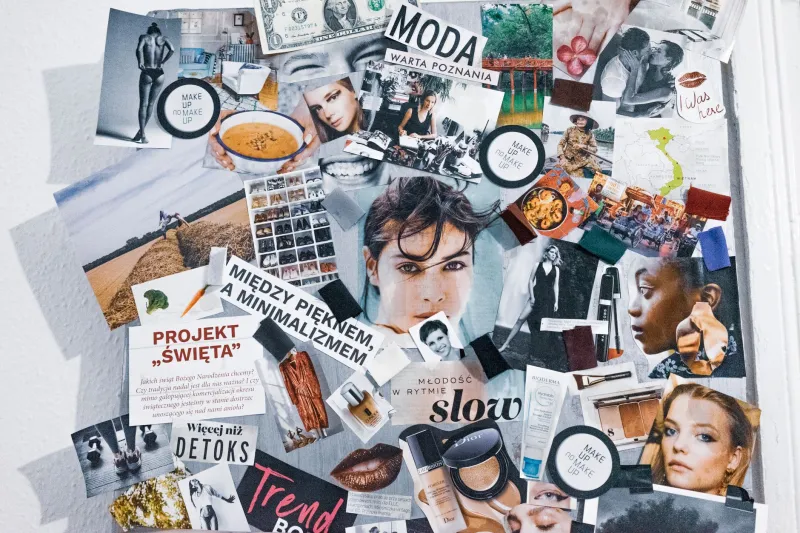
The single voice you've been told to find? It might already be there — it just looks messier and more interesting than you expected. It's the voice that knows how to speak in more than one visual language without losing itself in either. It's the voice that makes work that doesn't look like it came from a single tradition, because it didn't.
You're not still figuring out your aesthetic. You've been building it your whole life. The only question left is whether you're going to show it.