Nobody Was Trying to Teach You Anything — That's Why It Worked
Think about the person who shaped how you make things. Maybe it was a professor, maybe a coworker, maybe someone you followed online for years before you even understood why. Now ask yourself: were they trying to teach you?
Probably not. Not really. They were just doing.
There's something almost inconvenient about that realization, especially in a culture that's obsessed with packaging knowledge into courses, frameworks, and thought leadership positioning. We've gotten very good at performing expertise. But there's a quieter, older model for how influence actually moves between people — and it doesn't involve a single webinar.
The American Expert Industrial Complex
Somewhere along the way, the US creative world got convinced that the path from practitioner to influencer runs through content creation. You make work, then you explain your work, then you teach people how to make work like yours, and somewhere in there you become a brand. The LinkedIn carousel. The Substack. The masterclass. The "I've distilled 10 years of experience into this one framework" post.
None of that is inherently bad. But there's a cost. The moment you start packaging your process for consumption, you're no longer fully inside it. You're narrating from the outside. You're performing mastery rather than practicing it.
And weirdly, people can feel the difference — even when they can't name it.
Shodō and the Lesson Nobody Asked For
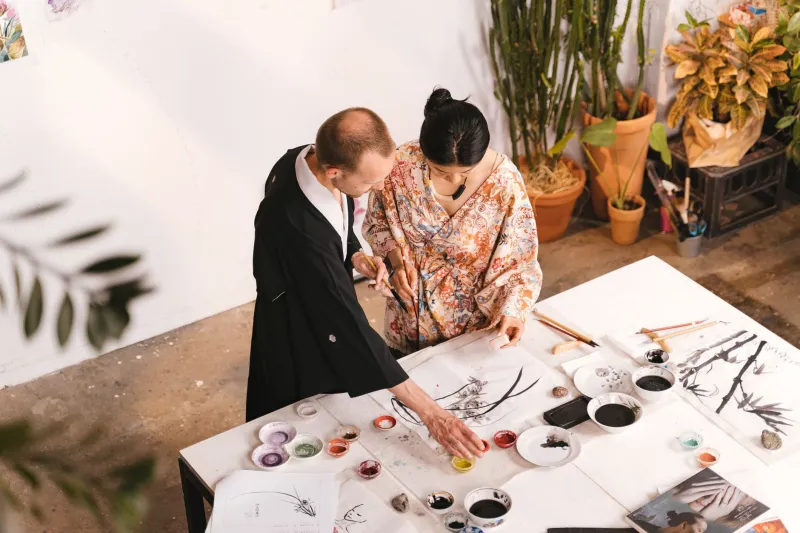
In Japanese calligraphy — shodō — a student might spend years watching a master work before attempting a single stroke themselves. The transmission isn't verbal. There's no PDF of best practices. The student learns by proximity, by attention, by absorbing the way a person inhabits their craft. The master isn't performing for the student. They're just doing what they've always done. The teaching happens as a byproduct of that.
This idea runs pretty deep in Japanese creative and philosophical traditions. There's a concept — ikigai — that gets oversimplified in Western wellness circles into a Venn diagram about finding your purpose. But at its core, ikigai is about the alignment between what you do and why you exist. When someone is living in that alignment, you don't need them to explain it. You can see it. You can feel the gravity of it. And if you're paying attention, you'll find yourself pulled toward it.
That pull? That's mentorship. Nobody called it that. Nobody scheduled it.
The Accidental Teacher Has No Curriculum
I've been thinking about a ceramicist I used to watch work at an open studio in the Bay Area. She never held workshops. Never had a newsletter. She just showed up, worked for hours, and occasionally talked to people who wandered in — not to instruct them, but because she was friendly and curious. She answered questions when asked, but she wasn't performing answers. She was just a person who knew a lot about clay and loved it visibly.
I learned more from watching her for three afternoons than I did from several structured classes I paid real money for. Why? Because she wasn't managing her image. She wasn't curating her vulnerability for relatability. She was just there, in the mess and the patience and the occasional frustration of the work.
That's the thing about quiet mastery — it's not quiet because it's shy. It's quiet because it doesn't need to announce itself.
Living Your Work Out Loud (Without Making It a Show)
There's a distinction worth drawing here between living your work out loud and performing your work for an audience. Both might look the same from the outside — both involve being visible, being present, letting people see your process. But the interior experience is completely different.
Performing your work means you're always aware of the camera, literal or metaphorical. You're making choices with an eye toward how they'll land. You're editing yourself in real time for maximum relatability or authority.
Living your work out loud means you're mostly just working — and you happen to not be hiding. The visibility is incidental. The audience, if there is one, is witnessing something real rather than something staged.
Bicultural creatives often develop a version of this almost by accident. When you're navigating two different aesthetic traditions, two different sets of cultural expectations, two different relationships to craft and expression — you can't really afford to perform. The translation work is hard enough. You're already spending enormous energy just figuring out what you actually think, what you actually want to make, what belongs to you across both worlds you carry. There's not a lot of bandwidth left for brand positioning.
And ironically, that authenticity — born of necessity, not strategy — is exactly what draws people in.
What You Model Is More Powerful Than What You Teach
Here's the uncomfortable part for anyone who's built a business around teaching creative skills: what you model is almost always more powerful than what you explicitly teach. People are watching how you handle the bad days, the failed projects, the work that didn't land. They're watching whether you actually live by the principles you advocate. They're watching what you do when no one's grading you.
A designer who talks about the importance of white space but whose own life is frantic and overscheduled — people notice that dissonance, even if they don't say so. A painter who preaches process over outcome but clearly gets defensive about negative feedback — that gap between the lesson and the life is visible.
Conversely, someone who just is the thing they're about — who moves through the world in a way that reflects their creative values without narrating it — that person teaches constantly, and they're not even trying.
The Mentorship You Never Applied For
If you're a working creative, you are almost certainly mentoring someone right now. Not because you signed up for it. Not because you have a coaching package or a community membership. Just because you're doing the work, and someone is watching, and something is transferring.
That's a kind of responsibility, but it's also a kind of freedom. You don't have to be perfect. You don't have to have a framework. You don't have to be further along than you are. You just have to be honest about where you are and keep moving.
The Japanese have a phrase — shoshin — often translated as "beginner's mind." It's the idea that staying open, staying curious, not calcifying into your own expertise, is itself a form of mastery. The best accidental mentors I've encountered all have this quality. They're not done learning. They're not performing arrival. They're still in it.
And that, more than any curriculum, is what's worth passing on.