Knowing When to Put Down the Brush: The Art of Calling Something Done
Somewhere between the fifth revision of a logo and the fourteenth draft of an artist statement, something quietly breaks. It's not the work itself — the work was probably fine three rounds ago. What breaks is the relationship between the creator and the thing they made. The work stops being a piece of art and starts being a problem to solve.
American creative culture has a complicated relationship with the word done. We celebrate iteration. We worship the pivot. We put "always be optimizing" on coffee mugs and call it wisdom. And there's real value in that restless energy — it's part of what makes American creative industries so generative, so loud, so capable of churning out genuinely new things. But there's a cost, and a lot of us are paying it without realizing.
The Feeling That Doesn't Translate
In Japanese, there's a sensibility — hard to pin to a single word — around the idea that a work contains its own moment of completion. It's not about hitting a checklist or satisfying a brief. It's closer to recognizing that something has arrived at its natural state, and that continuing to push past that point doesn't improve the work. It diminishes it.
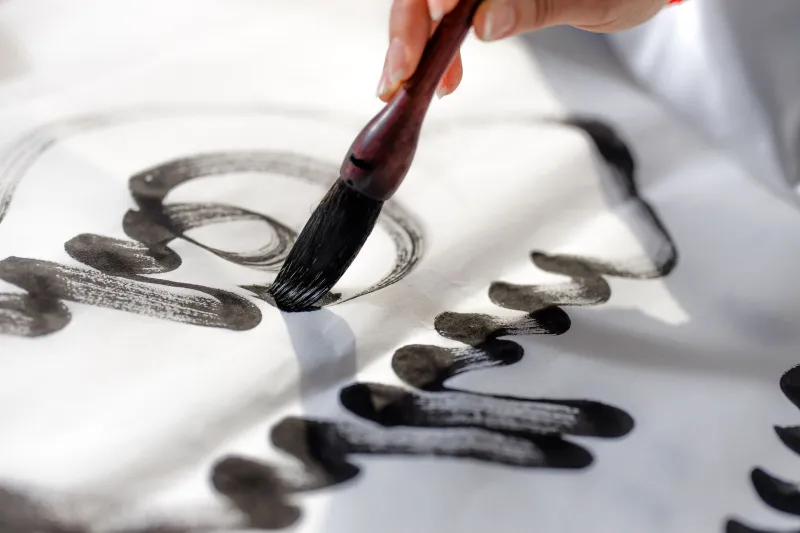
This shows up in practices like shodō (Japanese calligraphy), where a brushstroke is made once, with full commitment, and then it's done. There's no undo. No going back over it to thicken the line or smooth the edge. The stroke is what it is. The imperfections are part of the record — evidence of a real moment, a real hand, a real decision. The work is honest precisely because it wasn't endlessly corrected.
For creatives who grew up in the US, that's genuinely uncomfortable to sit with. We've been trained, from school projects to Slack feedback threads, to treat every piece of work as a draft. Final means "final for now." Done means "done until someone has notes."
What Bicultural Creatives Navigate Every Day
Talk to artists and designers who move between Japanese and American creative contexts, and you'll hear a version of the same story: the two cultures don't just have different aesthetics. They have different relationships with the act of finishing.
One graphic designer who splits her practice between clients in Tokyo and New York described it this way: in Tokyo, she said, presenting work feels like offering something. In New York, it feels like opening a negotiation. Neither is wrong. But they produce very different internal experiences — and very different work.
The negotiation model is efficient in some ways. It keeps stakeholders involved, catches problems early, and builds consensus. But it also means that work rarely gets to breathe on its own terms. It's always being measured against what it could still become, rather than appreciated for what it already is.
The offering model asks something harder of the creator: you have to actually decide what the work is before you show it. You have to commit. And that commitment requires a kind of internal clarity that the revision cycle often trains right out of us.
The Productivity Angle Nobody's Talking About
Here's the part that should get the attention of every American creative who's drowning in their own backlog: knowing when something is done is a skill, and it saves enormous amounts of time.
When you don't have an internal sense of completion — when "done" is just an external deadline rather than a felt state — you fill every available hour with more work on the same piece. You're not improving it at that point. You're managing anxiety. You're doing something that feels like progress because the alternative (declaring it finished and moving on) feels terrifying.
The Japanese concept of kansei — a sense of completion or perfection that comes from within — isn't about settling for less. It's about developing enough sensitivity to your own work that you can actually feel when it's arrived somewhere real. That's a skill. And like most skills, it atrophies when you never practice it.
Practicing it looks like this: finishing things and releasing them, even when part of you wants one more pass. Sitting with the discomfort of imperfection long enough to realize the imperfection isn't actually the problem. Noticing the difference between genuine incompleteness (the work really does need more) and creative anxiety dressed up as quality control.
Why "Perfect" Is Often a Delay Tactic
There's a version of perfectionism that's really just fear — fear of judgment, fear of misrepresentation, fear that the work won't be received the way you intended. And because that fear is uncomfortable, we give it a more respectable name. We call it high standards. We call it professionalism. We call it caring about quality.
Sometimes it is those things. But often, it's just the feeling of not wanting to be done, because being done means being seen, and being seen means being vulnerable to a response you can't control.
Japanese aesthetic traditions have a different answer to that vulnerability. Instead of trying to eliminate it through endless refinement, they build it into the work. The asymmetry in a tea bowl. The visible seam in a textile. The brushstroke that wobbles slightly at the end. These aren't failures to fix — they're evidence of presence. They're proof that a human being made this thing, at a specific moment in time, with everything they had available to them then.
That's actually a more honest form of quality than the smoothed-out, iterated-to-death version that American perfectionism tends to produce.
Learning to Feel the End
None of this means stop caring. It doesn't mean ship garbage and call it wabi-sabi. What it means is developing a more honest internal conversation about what your work actually needs versus what your anxiety is asking for.
Some questions worth sitting with: If the deadline disappeared tomorrow and you had unlimited time, would you actually make the work better — or would you just make it different? Is the thing you're about to change genuinely improving the piece, or are you changing it because stillness feels unbearable? And maybe most importantly: are you finishing the work, or are you hiding inside it?
The creatives who seem to produce the most — and the most interesting stuff — tend to have a clear relationship with completion. They finish things. They let them go. They move to the next thing with the energy that comes from actual closure rather than the slow drain of perpetual revision.
That's not a cultural luxury. That's a practice. And it starts with learning to feel the difference between a brushstroke that needs another pass and one that already said everything it had to say.
Put the brush down. The work is done.