Hurry Up and Wait: What Japanese Patience Can Teach American Creatives About Doing Less, Better
Let's be honest about something. American creative culture has a speed problem. Not just a preference for fast — an actual compulsion. Clients want concepts by Monday. Algorithms reward daily posts. Designers refresh their portfolios like they're afraid of being caught standing still. The whole ecosystem is built around the idea that momentum equals progress, and stopping, even briefly, is basically failure with better lighting.
So here's a thought that might feel a little uncomfortable: what if the pause is the work?
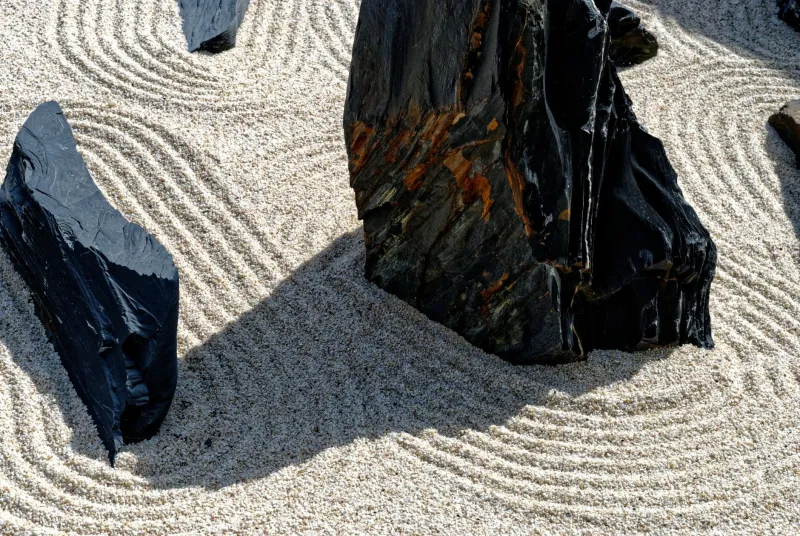
There's a concept in Japanese aesthetics called ma (間). Most people who've encountered it get told it means "negative space" or "emptiness," which is technically accurate but kind of misses the whole point. Ma isn't just the absence of something — it's the charged, intentional gap between things. The breath between musical notes. The silence after someone says something important. The white space on a page that makes the type feel like it has room to exist. Ma is a pause with purpose, and in Japanese art, architecture, theater, and design, it's treated not as a void to be filled but as an active ingredient.
American creatives are starting to notice. Slowly — which, honestly, is kind of the point.
What Rushing Actually Costs You
Here's something designers who work across cultures tend to learn the hard way: the first idea is almost never the right one. That's not a knock on instinct — instinct is valuable. But instinct needs time to settle before you can tell whether it's genius or just the first thing that came to mind.
When you're working at American creative speed — pitching concepts within 48 hours, iterating in real time, treating every revision as a race to the finish — you end up producing work that solves the surface problem. It answers the brief. It looks competent. But it rarely surprises anyone, including yourself. There's no room for the idea to breathe long enough to become something unexpected.
Take logo design as a simple example. The designers who wait — who sit with a concept for a few days before showing it to anyone, who let themselves feel genuinely uncertain about something before committing — tend to come back with work that has a different quality to it. Not more polished, necessarily. More considered. You can feel the difference even if you can't always name it.
That feeling? That's ma doing its thing.
The Creative Case for Deliberate Waiting
Illustrator and designer Yuko Shimizu, who splits her practice between New York and Tokyo influences, has talked in interviews about the way Japanese creative training builds in structured periods of non-doing. Not procrastination — something more intentional. You work intensely, and then you stop and let the work exist without you for a while. You come back to it with fresh eyes, but also with a kind of emotional distance that makes honest evaluation possible.
This is wildly at odds with how most American studios operate, where the pressure to show progress is constant and "I'm still thinking" reads as a billing problem.
But the research on creative incubation — the psychological term for what happens when you step away from a problem — consistently shows that the brain keeps working on things when you're not consciously attending to them. The shower epiphany is real. The solution that arrives on a Tuesday morning after you stopped thinking about it on Friday is real. The ma is doing something, even when it looks like nothing.
Writers know this intuitively. The best editors will tell you that a draft needs to sit before you can see it clearly. Poets revise over months, sometimes years. Novelists famously abandon manuscripts and return to them transformed. The waiting isn't wasted time — it's part of the process, and pretending otherwise produces work that shows the seams.
What This Looks Like in Client Relationships
Here's where things get practical and, frankly, a little uncomfortable for anyone trying to run a creative business in the US.
Building ma into your process means having honest conversations with clients about timelines — not to be precious about your work, but because rushed work genuinely doesn't serve them. Some clients get this immediately. Others need to see the difference in outcomes before they believe it.
A few designers who've adopted slower, more deliberate workflows report that their client relationships actually improve once the initial adjustment period is over. When you stop delivering concepts in 24 hours, clients stop expecting them. When you say "I want to sit with this brief for a week before we talk again," some clients initially panic — and then come back to the conversation more prepared themselves. The pause becomes contagious in the best possible way.
There's also something to be said for the confidence that comes through in work that wasn't rushed. Clients can sense when a designer is certain, and certainty is hard to fake when you haven't actually given yourself time to arrive at it.
Slowness Isn't Laziness — But You'll Have to Prove That
The cultural reframe here is the hard part. In a country where "I've been so busy" functions as a status symbol and productivity hacks are a billion-dollar industry, choosing deliberate slowness requires a kind of confidence that doesn't come naturally to everyone. It can feel like falling behind, even when you're not.
But there's a growing counter-movement, especially among creatives who've been burned by the hustle-until-you-break model. Designers who've restructured their practices around fewer projects, longer timelines, and intentional non-doing are reporting not just better work but better relationships with the work itself. Less burnout. More of those rare, genuinely exciting moments when something you made surprises you.
That's the thing about ma that doesn't translate easily into a productivity framework: it's not a technique you apply. It's a relationship with time that you develop. And like most meaningful relationships, it takes — you guessed it — a while.
The Space That Makes Everything Else Possible
Japanese aesthetics have always understood something that Western design culture keeps rediscovering and forgetting: the space between things is not empty. It's full of potential, of resonance, of all the meaning that gets crowded out when you fill every available moment with output.
For American creatives willing to sit with that discomfort — to resist the pull toward constant production and let the pause do its work — the results tend to be worth the wait. Not always. Not automatically. But often enough that it changes how you think about what creative work actually is.
Maybe the most radical thing a designer or artist can do right now isn't to move faster, post more, or iterate harder. Maybe it's to stop. Intentionally. And trust that something is happening in the stillness that couldn't happen any other way.
That's ma. And America, honestly, could use a lot more of it.