The Five-Minute Ritual That's Saving Burned-Out Designers From Themselves
When the Work Stops Feeling Like Work (In the Bad Way)
There's a specific kind of exhaustion that creative burnout produces — one that's different from just being tired. It's the feeling of sitting in front of a blank canvas or an open file and having absolutely nothing to give it. Not a block, exactly. More like a depletion. Like someone quietly drained the tank while you weren't paying attention.
For a lot of American designers right now, that's not a rare bad day. It's Tuesday.
The hustle-culture model that dominated creative industries for the better part of a decade — more clients, faster turnarounds, always-on availability, productivity measured in deliverables per week — has produced a generation of genuinely skilled people who've forgotten what it feels like to be curious about their own work.
Something is shifting, though. Quietly, without much fanfare, a growing number of designers are turning toward a different model. Not a productivity system. Not a new app. Something older and considerably less glamorous: ritual.
What Japanese Craftsmanship Actually Looks Like Up Close
The word "ritual" gets overused in wellness content, so let's be specific about what we mean here. In Japanese craftsmanship traditions — whether you're looking at the culture around ceramics, woodworking, textile arts, or the tea ceremony — daily practice isn't a motivational concept. It's structural. It's the scaffolding the work is built on.
A Japanese potter doesn't begin throwing clay the moment inspiration strikes. They begin with preparation: cleaning the workspace, centering themselves, handling materials with a deliberateness that signals to the brain that something intentional is about to happen. The ritual isn't separate from the work. It's the on-ramp to the work.
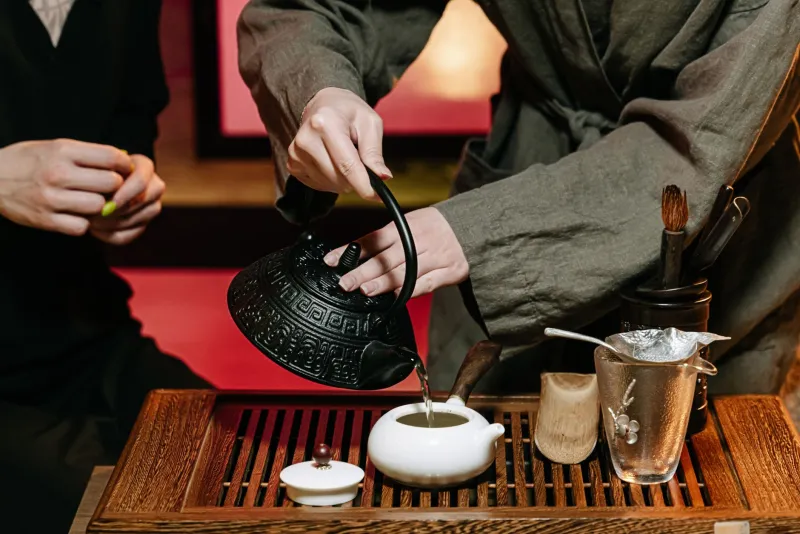
The tea ceremony (chado) is probably the most well-known example of this in Western cultural awareness, though it's often misunderstood as a quaint formality. What it actually demonstrates is the power of a highly structured sequence of small, precise actions to produce a particular state of mind — focused, present, unhurried. The ceremony is a technology for attention.
For designers who've tried to import this logic into a modern American creative practice, the results have been quietly transformative.
What Designers Are Actually Doing
Nobody's setting up tatami mats in their studio (well, maybe somebody is). The rituals that working designers describe tend to be modest, personal, and specific to their own relationship with making.
Morning sketching before screens. Several designers in editorial and branding have described a practice of spending the first fifteen to thirty minutes of their workday sketching by hand — not sketching for anything, just sketching. No brief, no client, no outcome. The point isn't to generate ideas. The point is to wake up the hand and remind the brain that it knows how to make things without being asked to.
The studio reset. Borrowed loosely from the Japanese concept of oosoji (the deep seasonal cleaning traditionally done at year's end), some designers have adopted a quarterly or monthly ritual of physically resetting their workspace — clearing surfaces, reorganizing tools, sometimes rearranging furniture entirely. The act of intentionally preparing the environment signals a transition. You're not just tidying up. You're telling yourself something new is beginning.
The single-task window. One brand designer described blocking ninety minutes each morning as a protected single-task period — no Slack, no email, no switching. She described it as "the closest I've gotten to what I imagine flow used to feel like before I had a smartphone." The ritual isn't the time block itself; it's the consistent, deliberate act of honoring it.
Material handling as meditation. Several illustrators and product designers mentioned the practice of spending a few minutes each day handling physical materials — paper, fabric, clay, even just different pens — without any intention of producing something. Just touching things. Feeling textures. Reestablishing a sensory relationship with making that screen-based work tends to erode.
Why Small Works When Big Fails
The counterintuitive thing about all of these practices is how unambitious they look on paper. Fifteen minutes of sketching. A quarterly desk reset. Ninety minutes without notifications. None of this sounds like a productivity revolution.
That's exactly the point.
American productivity culture tends to favor interventions that feel proportional to the problem — if you're burned out, you need a serious overhaul. A retreat. A new system. A complete restructuring of your workflow. The idea that five minutes of intentional stillness before opening your laptop could meaningfully change your creative output feels almost insulting in its simplicity.
But the Japanese craftsmanship model isn't built on dramatic transformation. It's built on kaizen — continuous, incremental improvement through consistent small actions. The premise is that quality of attention matters more than quantity of effort, and that attention is a skill that atrophies without practice.
Rituals maintain the practice. They keep the instrument tuned even when you're not performing.
Starting Without Overthinking It
If you're reading this in the middle of a brutal deadline stretch and the idea of adding anything to your day sounds absurd, start with something that takes less time than checking Instagram.
Before you open your design software tomorrow morning, make something with your hands that has nothing to do with your job. Fold a piece of paper. Doodle on a Post-it. Sharpen a pencil you haven't used in six months. Do it slowly. Do it on purpose.
That's the whole ritual. That's the beginning.
The work will still be there in five minutes. But you might show up to it slightly differently — a little more present, a little less depleted, a little more like someone who chose this profession because they actually love making things.
That's not a small thing. In the current creative landscape, that might be the most radical thing of all.